Used in research worldwide: how 60+ studies put Mapit GIS in the field

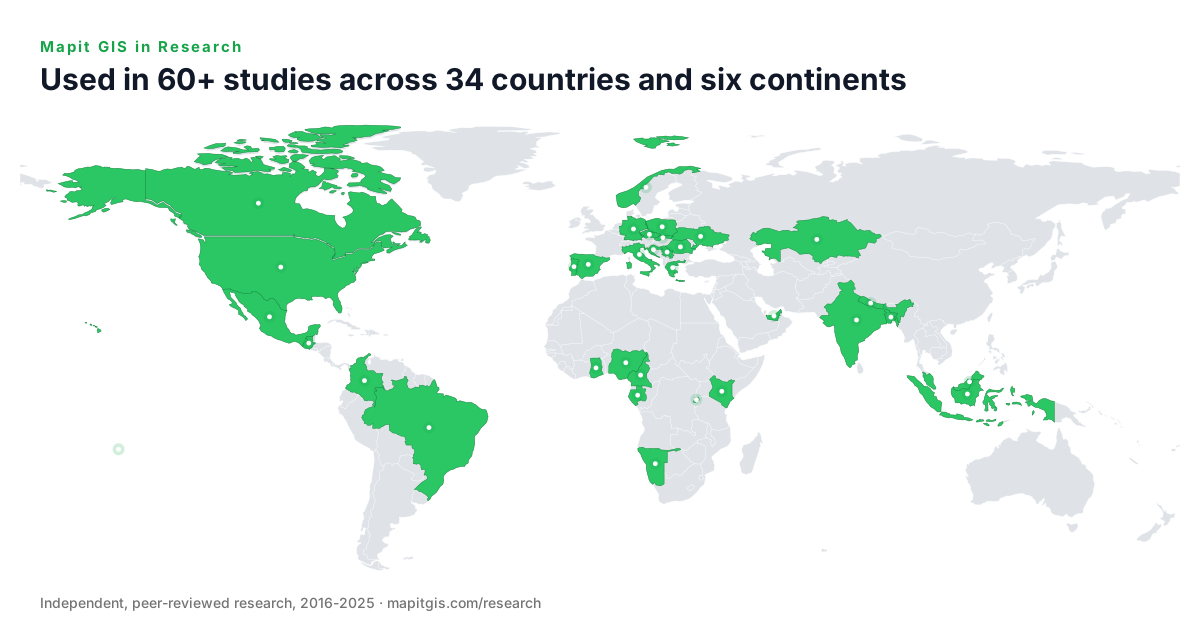
We build Mapit GIS for people doing real work in the field. So it's genuinely rewarding to find that researchers, with no prompting from us, have chosen Mapit for their studies and published the results. Quietly, since 2016, Mapit has appeared in more than 60 peer-reviewed journals, conference proceedings, theses, and reports across 34 countries and six continents.
Here's a short tour.
Trusted for land administration - by the people who define the field
The deepest evidence is in cadastre and fit-for-purpose land administration (FFPLA) - and it includes some of the discipline's most authoritative voices:
- In Nepal, Mapit was used to collect parcel boundaries for a cadastral-map validation study co-authored by Christiaan Lemmen, co-author of the international LADM land-administration standard (University of Twente ITC / FIG).
- In Greece and Romania, Mapit was the open-source field collector for crowdsourced cadastral surveys led by a former President of FIG, the International Federation of Surveyors (ISPRS Int. J. of Geo-Information, 2020).
- In Namibia, a TU Munich team used Mapit to measure plot boundaries for the country's Flexible Land Tenure System (Survey Review, 2022); and across Ghana, Kenya and Namibia it was the core para-surveyor parcel-mapping tool in three FFPLA case studies (Land, 2021).
- In Indonesia, several studies of the national PTSL land-registration programme rated Mapit "very effective" against the ISO/IEC 9126 software-quality standard - and the national geospatial agency used it as the field controller for centimetre-grade RTK cadastral survey.
Given that only about 30% of the world has formal land records, that's a meaningful pattern.
Environmental and marine science
On a coral-reef island in French Polynesia, a team monitoring long-term coastline change called the Mapit-based method "fast, precise, and very inexpensive," with "repeatability and transferability" (Ocean & Coastal Management, 2019). A peer-reviewed state-of-the-art review of mobile GIS apps for environmental surveys featured Mapit Spatial among the leading tools (Global Ecology & Conservation, 2020). And in the forests around Mexico City, capturing coordinates with Mapit's device GPS prevented data-entry errors in a participatory ozone-damage study (Conservation Biology, 2023).
The reach keeps going: wetland remote sensing (Poland), coastal-flood vulnerability (Cameroon), an endemic-macroalga climate-risk study (Canary Islands), landslide and disaster-risk surveys (Mexico, Serbia, Gabon, Italy), irrigated-area and crop ground-reference mapping (Italy, Mexico), UAV tree-height-growth and breeding-bird surveys (Germany), and urban tree inventories and tree-health mapping (Brazil, Guatemala, Poland).
Public health, infrastructure, and beyond
A connected international neglected-tropical-disease network (NLR, NHR, Erasmus MC) uses Mapit to map leprosy, tuberculosis and COVID-19 cases across Bangladesh, India and Brazil - in journals like PLOS Neglected Tropical Diseases and BMC Infectious Diseases. Elsewhere it's mapped pedestrian lighting for a US Department of Transportation pilot, water-supply networks (India, Cameroon), waste-collection routes (Malaysia), and archaeological fieldwork from contemporary-heritage recording in Norway to a palm-garden rescue survey in the United Arab Emirates.
What keeps coming up
Across these very different projects, researchers value the same things: it's easy to use for non-specialists and para-surveyors, it works offline, it stores data in open formats (GeoPackage, with one-tap export to QGIS), it captures points, lines, polygons, attributes and photos together, and it's affordable and fast to deploy. Recent releases add advanced editing, GeoPDF and GeoTIFF support, new export formats including GeoParquet, and high-accuracy positioning in Mapit Pro+.
You can browse the full, growing list - grouped by field, with links - on our Mapit in Research page.
We'd like to support researchers
If you're using Mapit GIS in your research, or planning to, we want to help, and we'd love to hear what you're building and what would make Mapit better for fieldwork. Get in touch or send us feedback.
The studies mentioned here were conducted independently by their authors; we cite their published work and make no claim of endorsement or affiliation.