Mapit in Research
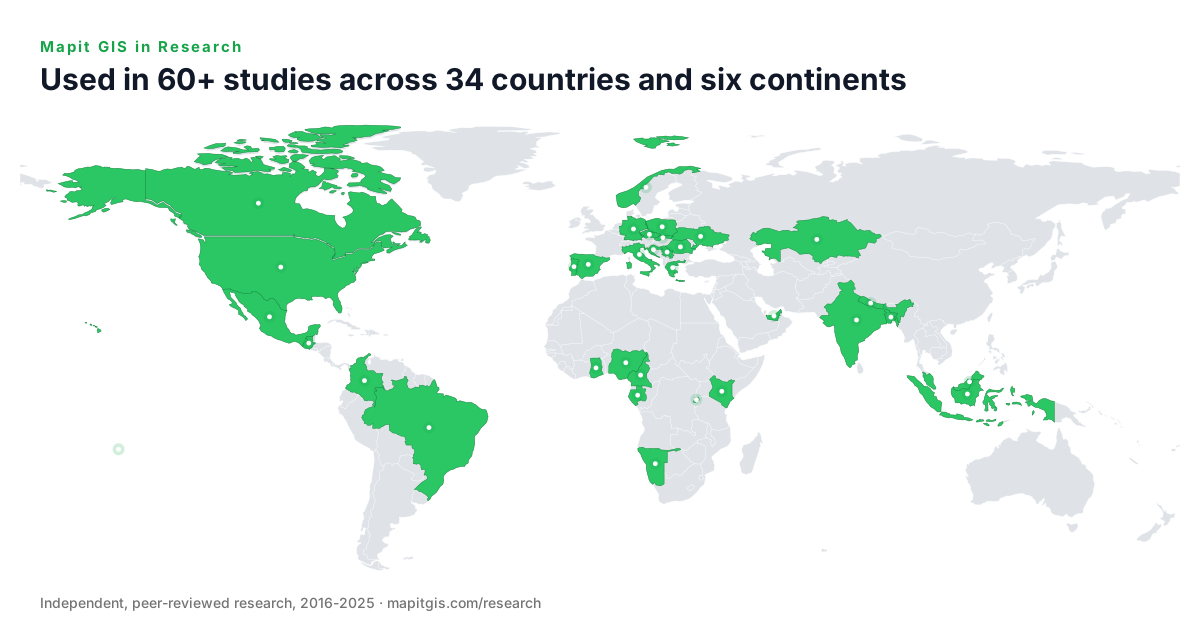
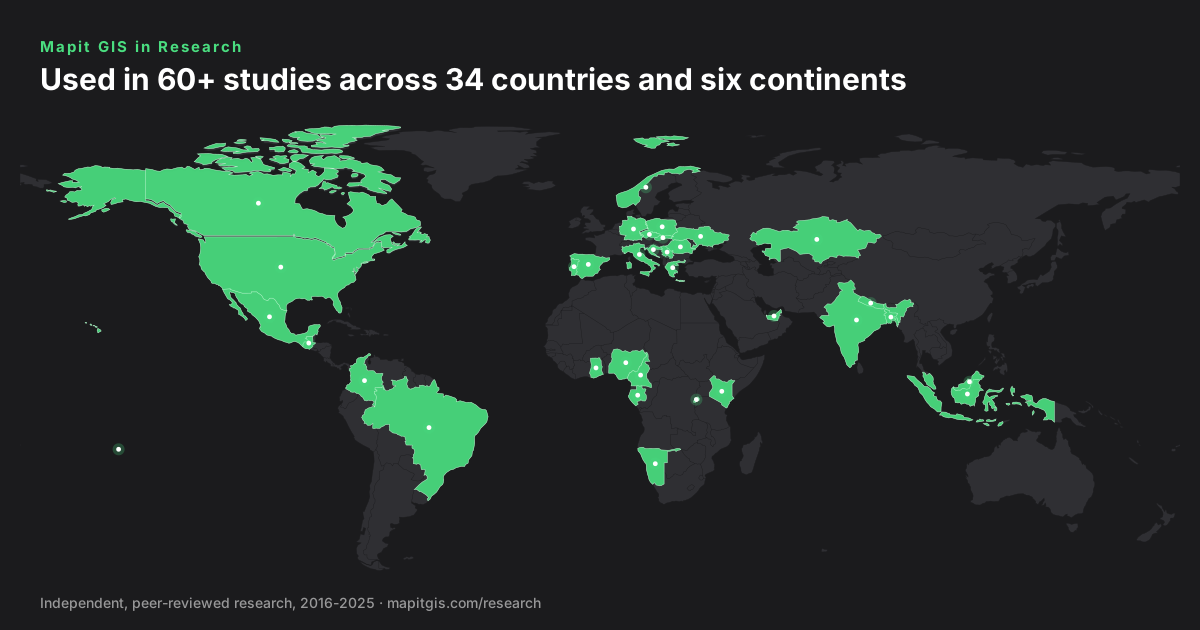
Researchers have chosen Mapit GIS for their fieldwork all over the world. Independently, without any involvement from us, Mapit has appeared in 60+ peer-reviewed journals, conference proceedings, theses, and reports since 2016, spanning 34 countries and territories across six continents, including some of the most authoritative voices in their fields.
These are independent studies by their authors. We're simply proud that Mapit has been useful to them.
How to cite Mapit GIS
Using Mapit GIS in a paper, thesis, or report? Please cite it - and include the version you used (find it in the app under Settings → About). A suggested format:
Mapit GIS Ltd. (YYYY). Mapit GIS (Version X.Y.Z) [Mobile application software]. https://mapitgis.com
Replace X.Y.Z with the version you used and YYYY with its release year - the version number is shown in the app under Settings → About (Android and iOS).
BibTeX:
@misc{mapitgis,
  author       = {{Mapit GIS Ltd.}},
  title        = {Mapit GIS},
  howpublished = {Mobile application software},
  version      = {X.Y.Z},
  year         = {YYYY},
  url          = {https://mapitgis.com}
}
If you publish work that uses Mapit, let us know - we keep this page up to date and would love to feature your study.
Where Mapit has been used
Europe: Poland, Slovakia, Czechia, Germany, Croatia, Serbia, Romania, Ukraine, Greece, Spain, Italy, Norway, Portugal · Asia: Indonesia, Nepal, India, Bangladesh, Malaysia, Kazakhstan, United Arab Emirates · Africa: Nigeria, Cameroon, Ghana, Kenya, Rwanda, Gabon, Namibia · Americas: Mexico, Guatemala, Brazil, Colombia, USA, Canada · Oceania: French Polynesia.
Land administration and cadastre
This is where the evidence is deepest. Mapit has been used for cadastral mapping and fit-for-purpose land administration (FFPLA) by several of the field's leading authorities:
- Nepal - used to collect parcel boundaries in a cadastral-map validation study by researchers from the global FFPLA community (incl. Christiaan Lemmen, co-author of the LADM land-administration ISO standard). FIG / University of Twente ITC.
- Greece and Romania - Mapit was the open-source field collector for crowdsourced cadastral surveys (property boundaries, building attributes) led by a former President of FIG (the International Federation of Surveyors). ISPRS Int. J. of Geo-Information, 2020.
- Namibia - used to measure plot boundaries for the Flexible Land Tenure System, by a TU Munich land-management team. Survey Review, 2022.
- Ghana, Kenya and Namibia - the core para-surveyor parcel-mapping tool in three FFPLA case studies. Land, 2021.
- Indonesia - multiple studies on the national land-registration programme (PTSL), one rating Mapit "very effective" against the ISO/IEC 9126 software-quality standard, and the national geospatial agency (BIG) using Mapit as the field controller for RTK (centimetre-grade) cadastral survey.
Honest note: studies find Mapit well-suited to cadastral mapping and work maps; legal cadastral measurement calls for high-accuracy positioning (external RTK GNSS, or Mapit Pro+).
Environmental, marine and field surveys
- Coastal monitoring, French Polynesia. Mapit was the core field tool for long-term coral-reef coastline monitoring; the method is described as "fast, precise, and very inexpensive," with "repeatability and transferability." Ocean & Coastal Management, 2019.
- State-of-the-art review. A peer-reviewed review of mobile GIS apps for environmental field surveys features Mapit Spatial among the leading tools. Global Ecology & Conservation, 2020.
- Forest pollution monitoring, Mexico. Device-GPS capture with Mapit prevented coordinate-entry errors in a participatory ozone-damage study. Conservation Biology, 2023.
- Plus wetland remote sensing (Poland), coastal-flood vulnerability (Cameroon), an endemic-macroalga climate-risk study (Canary Islands, Spain), landslide and disaster-risk surveys (Mexico, Serbia, Gabon, Italy), irrigated-area and crop-sowing-date ground reference (Italy, Mexico), urban tree inventories and tree-health mapping (Brazil, Guatemala, Poland), UAV forestry and breeding-bird surveys (Germany), and archaeological / heritage field survey (Norway; palm-garden rescue mapping in Ras al-Khaimah, UAE).
Public health and disease mapping
A connected international neglected-tropical-disease network (NLR, NHR, Erasmus MC) uses Mapit to map disease cases:
- Leprosy geospatial epidemiology in Bangladesh (40 field staff over ~7 million people), India, and Brazil; and COVID-19 / TB / leprosy distribution in Fortaleza, Brazil - in reputable journals (Infectious Diseases of Poverty, PLOS Neglected Tropical Diseases, BMC Infectious Diseases).
Infrastructure and public services
- A US Department of Transportation pedestrian-lighting pilot (University of Delaware); water-supply network mapping (India, Cameroon); municipal waste-collection route optimisation (Malaysia); a road speed-bump inventory (Brazil); and a proposed traffic-management system (Ukraine).
What researchers value
Across these very different projects, the same strengths recur:
- Ease of use for non-specialists and para-surveyors in the field.
- Works offline -
.mbtilesbasemaps, GPS positioning, no signal. - Open formats - a GeoPackage core with one-tap export to shapefiles and QGIS.
- Rich capture - points, lines, polygons, custom attributes and photos in one record.
- Affordable and fast to deploy for repeatable, transferable field methods.
Recent releases added advanced editing, GeoPDF and GeoTIFF support, new export formats including GeoParquet, and high-accuracy positioning in Mapit Pro+.
Publications
A growing list of the studies, theses, and reports that have used Mapit GIS, grouped by field.
Land administration and cadastre
- Kohli, D., Unger, E.-M., Lemmen, C., Bennett, R., Koeva, M., Friis, J., & Bhandari, B. "Validation of a cadastral map created using satellite imagery and automated feature extraction techniques: A case of Nepal." FIG / University of Twente ITC. Paper
- Potsiou, C., Paunescu, C., Ioannidis, C., Apostolopoulos, K., & Nache, F. (2020). "Reliable 2D Crowdsourced Cadastral Surveys: Case Studies from Greece and Romania." ISPRS Int. J. of Geo-Information 9(2), 89. DOI
- Chigbu, U.E., Bendzko, T., Mabakeng, M.R., Kuusaana, E.D., & Osei Tutu, D. (2021). "Fit-for-Purpose Land Administration from Theory to Practice: Three Demonstrative Case Studies in Africa." Land 10(5), 476. DOI
- Lauterbach, R., & de Vries, W.T. (2022). "Beyond accuracy: evaluating alternative measurement methods in context of Flexible Land Tenure System in Namibia." Survey Review 54(385), 281-289. DOI
- Manurung, P., Pramujo, H., & Manurung, J.BP. (2019). "Development of GNSS Receiver for Mobile CORS with RTK Correction Services Using Cloud Server." E3S Web of Conferences 94, 01010. DOI
- Aji, E.P., Suyudi, B., & Wahyuni (2019). "Pemanfaatan Aplikasi Mapit GIS untuk Pendaftaran Tanah Sistematis Lengkap di Kabupaten Cianjur." Jurnal Tunas Agraria 2(3). Link
- Ariwibowo, M.M., Suharno, & Wahyuni (2020). "Efektivitas Pemanfaatan Aplikasi Locus GIS dan Mapit GIS untuk Pengumpulan Data Pendaftaran Tanah." Jurnal Tunas Agraria 3(1). Thesis
- Mustofa, F.C., Aditya, T., & Sutanta, H. (2018). "Evaluasi Pemanfaatan Aplikasi MapIt GIS sebagai Alat Pengumpul Data Pertanahan untuk Pendaftaran Tanah." SIIG 2018 (UGM / BPN). Zenodo
- Rasyid, Z.A. (2018). "Penggunaan Aplikasi Mapit GIS dalam Pengukuran dan Pemetaan Kadastral (Poso)." Diploma IV thesis, STPN. Link
- Sundawa, A.K., et al. (c. 2021). "Pembuatan Peta Desa Carangrejo berdasarkan Peraturan Kepala BIG No. 3/2016." Tugas Akhir, Universitas Winaya Mukti. Repository
Environmental, marine and field surveys
- Madi Moussa, R., et al. (2019). "Long-term coastline monitoring on a coral reef island (Moorea, French Polynesia)." Ocean & Coastal Management 180, 104928. DOI
- Nowak, M.M., Dziób, K., Ludwisiak, Ł., & Chmiel, J. (2020). "Mobile GIS applications for environmental field surveys: A state of the art." Global Ecology & Conservation 23, e01089. DOI
- Reyes-Galindo, V., et al. (2023). "Evaluating pollution-related damage and restoration success in urban forests with participatory monitoring and digital tools." Conservation Biology. DOI
- Jarocińska, A., et al. (2023). "Testing Textural Information Base on LiDAR and Hyperspectral Data for Mapping Wetland Vegetation (Poland)." Remote Sensing 15(12), 3055. DOI
- Ebodé, V.B., et al. (2024). "Vulnerability of Populations to Flooding and Marine Submersion in the Wouri Estuary (Cameroon)." Estuaries and Coasts 48, 28. DOI
- Alfonso, B., et al. (2021). "Fast climatic changes place an endemic Canary Island macroalga at extinction risk." Regional Environmental Change 21, 113. DOI
- Garnica-Peña, R.J., & Alcántara-Ayala, I. (2021). "On the Use of UAVs for Landslide Exposure of Households." In Understanding and Reducing Landslide Disaster Risk, Springer. DOI
- Mavoungou-Mavoungou, W.N., Okanga-Guay, M., & Mombo, J.-B. (2026). "Hierarchical Multicriteria Analysis... Ground Movement Susceptibility Mapping (Gabon)." In Earth Observation: Pillar of Socioeconomic Development of Africa, Springer. DOI
- Andrejev, K., Marjanović, M., & Petrović, R. (2024). "Landslide mapping for the regional gas pipeline construction near Priboj (Serbia)." ResyLab 2024. DOI
- Conversi, S. (2021). "Design of a WebGIS Platform to Support Dam Crisis Management in Seismic Emergency." MSc thesis, Politecnico di Milano. Repository
- Horowitz, F.G. (2020). "Potential Field Surveys... for Cornell's Earth Source Heat Project." Cornell eCommons. Report
- Rodrigues, M.V.C., et al. (2022). "Urban watershed management prioritization using the rapid impact assessment matrix (RIAM-UWMAP), GIS and field survey." Environmental Impact Assessment Review 94, 106759. DOI
- Lepoglavec, K., et al. (2019). "Mobile Applications: Useful Innovation in Forestry?" Nova mehanizacija šumarstva 40. DOI
- Muhamad, H., et al. (2023). "Assessment of Water Quality and Phytoplankton Abundance in Tuba Island, Malaysia." Springer / MedGU. DOI
- Zafeiropoulos, A., & Tarnaras, T. (2023). "Control of Nitrate ion residues in water and vegetables in the Prefecture of Ilia." Diploma thesis, University of Patras. Nemertes
- Barreiros, H.C.C., da Silva, W.C., & Valverde, K.C. (2023). "Diagnóstico quantitativo da arborização no loteamento Terra Nova em Macapá." Biologia em Pauta (ch. 1), Editora Integrar. DOI
- Gonçalves, P., et al. (2021). "What's biodiversity got to do with it? Perceptions of biodiversity and restorativeness in urban parks." Ecology and Society 26(3), 25. DOI
- Graf, P. (2022). "Evaluación multiperspectiva de las palmas de Sabal... por los antiguos mayas." Estudios de Cultura Maya LIX, 37-83. Article
- Magnani, M., Venovcevs, A., Farstadvoll, S., & Magnani, N. (2021). "How to Record Current Events like an Archaeologist." Advances in Archaeological Practice (Cambridge). DOI
- Bhattacharya, B.K., Chowdary, V.M., et al. (2024). "Inventory and mapping of kharif crops using machine learning with EOS-04 time-series SAR data." Current Science 126(9), 1050-1060. DOI
- Tohura, U., Islam, M.M., & Shoeb, M. (2025). "Characterization and Quantification of Microplastics in Surface Water of Shitalakshya River, Bangladesh." Dhaka University Journal of Science 73(1), 57-66. DOI
- Więckowski, M., Łaska, W., Timothy, D.J., Michniak, D., & Cyargeenka, A. (2024). "From closed border to open tourist space: Landscape changes along the Polish-Slovak border." GeoJournal 89, 33. DOI
- Dempewolf, J., Nagol, J., Hein, S., Thiel, C., & Zimmermann, R. (2017). "Measurement of Within-Season Tree Height Growth in a Mixed Forest Stand Using UAV Imagery" (Rottenburg, Germany). Forests 8(7), 231. DOI
- Zakrzewska, A., Kopeć, D., Ochtyra, A., & Potůčková, M. (2023). "Can canopy temperature acquired from an airborne level be a tree health indicator in an urban environment?" (Warsaw, Poland). Urban Forestry & Urban Greening 79, 127807. DOI
- Falanga Bolognesi, S., Pasolli, E., Belfiore, O.R., De Michele, C., & D’Urso, G. (2020). "Harmonized Landsat 8 and Sentinel-2 Time Series Data to Detect Irrigated Areas: An Application in Southern Italy." Remote Sensing 12(8), 1275. DOI
- Prudente, V.H.R., et al. (2025). "Mapping grain crop sowing date in smallholder systems using optical imagery" (Mexico). Remote Sensing Applications: Society and Environment 39, 101660. DOI
- Kdolska, H., & Connolly, D. (2022). "Mapping the Shimal plain, Ras al-Khaimah" (UAE): the Shimal Plain Palm Gardens Project. Proceedings of the Seminar for Arabian Studies 51, 201-220. JSTOR
- Botero-Ramirez, A., Hwang, S.-F., & Strelkov, S.E. (2021). "Plasmodiophora brassicae Inoculum Density and Spatial Patterns at the Field Level and Relation to Soil Characteristics" (Alberta, Canada). Pathogens 10(5), 499. DOI
Public health and disease mapping
- Bulstra, C.A., et al. (2021). "Geospatial epidemiology of leprosy in northwest Bangladesh: a 20-year retrospective observational study." Infectious Diseases of Poverty 10, 36. DOI
- Taal, A.T., et al. (2022). "Identifying clusters of leprosy patients in India: A comparison of methods." PLOS Neglected Tropical Diseases 16(12), e0010972. DOI
- Taal, A.T., et al. (2023). "The geographical distribution and socioeconomic risk factors of COVID-19, tuberculosis and leprosy in Fortaleza, Brazil." BMC Infectious Diseases 23, 662. DOI
- Ribeiro, G.C., et al. (2021). "Combined use of serologic markers and spatial analysis for epidemiological surveillance of leprosy." Rev. Panamericana de Salud Pública. Article
- Andrade, E.A., et al. (2022). "Factors associated with adherence to annual rabies vaccination in dogs and cats... Eastern Amazon." bioRxiv (preprint). DOI
Infrastructure and public services
- DeCoursey, W., Braun, D., & Oza, J. (2019). "Pedestrian Lighting, Acceptable Levels of Light: A Pilot Project." University of Delaware IPA / DelDOT. Report
- Chaudhari, A., & Wayal, A. (2020). "GIS based current analysis and efficiency improvement of building water supply network." IOP Conf. Ser.: Earth Environ. Sci. 500, 012083. DOI
- Ahmad Umar, A.S., & Mohd Bukari, S. (2023). "A Study of Managing Transportation Route in Food Waste Collection Using Mobile GPS and GIS." RTCEBE 4(2), 82-90. DOI
- Braz Rodrigues, V. (2022). "Análise das ondulações transversais nas vias públicas (Patos-PB)." TCC, Centro Universitário de Patos (UNIFIP). Link
- Verenych, O., et al. (2025). "The Technological Aspect of Digitalizing Traffic Management in Settlements under Martial Law and During Post-War Reconstruction." CEUR Workshop Proceedings Vol-4023. PDF
Other domains
- Issakov, Y., et al. (2022). "Opportunities to Use Mobile GIS Applications in the Formation of Tourist and Local Lore Competencies in Students (Almaty, Kazakhstan)." GeoJournal of Tourism and Geosites 41(2), 597-605. DOI
- Buršík, M. (2021). "Možnosti tematického mobilního mapování GIS... pro územně analytické podklady měst." Bachelor thesis, Masaryk University. Link
- Costa, F.F. (2018). "Sistema de Informações Geográficas como ferramenta para o mapeamento dos setores de indústrias, comércios e serviços (Castanhal)." TCC, Universidade Federal do Pará. Repository
- Serna M., E. (Ed.) (c. 2021). Investigación Formativa en Ingeniería (4th ed.), Editorial Instituto Antioqueño de Investigación, Colombia. Book
Using Mapit in your research?
If you're using Mapit GIS in your work, or planning to, we'd love to hear about it and to support you. Get in touch or send us feedback.
The studies listed here were conducted independently by their authors. Their inclusion reflects published use of Mapit GIS and is not a claim of endorsement or affiliation. Spotted an error, or want your work added or removed? Let us know.